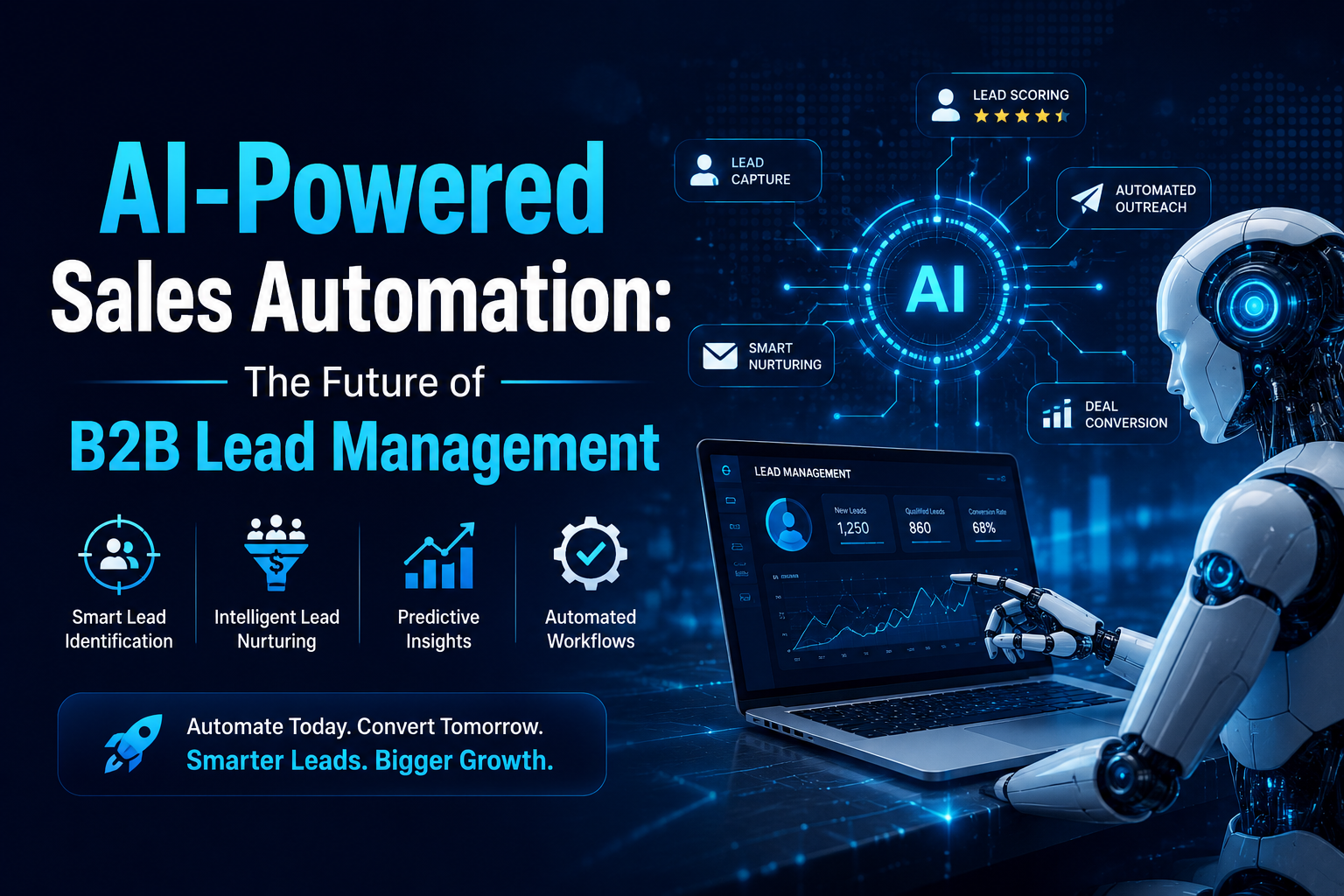
If your sales team is still manually qualifying leads,
sending follow-up emails one by one, and updating CRM records by hand — you are
not just losing time. You are losing revenue. In today's B2B landscape, speed,
precision, and personalization at scale are no longer competitive advantages.
They are the minimum standard. And the only way to meet that standard without
burning out your salespeople is AI-powered sales automation.
This is not a future concept. It is happening right now,
inside the fastest-growing B2B companies in the United States. And if you are
not already deploying it, your competitors are.
What Is AI-Powered Sales Automation?
AI-powered sales automation combines machine learning,
natural language processing, and predictive analytics to handle the repetitive,
time-consuming parts of the B2B sales cycle — automatically, intelligently, and
at a scale no human team can match.
This goes far beyond basic email sequences or CRM auto-fill.
Modern AI sales platforms can:
- Score
and rank inbound leads in real time based on hundreds of behavioral
signals
- Engage
prospects via conversational AI chatbots that feel genuinely human
- Predict
which accounts are most likely to close — and when
- Auto-personalize
outreach based on a prospect's industry, role, company size, and digital
behavior
- Trigger
follow-up sequences the moment a lead goes cold or shows renewed intent
- Sync
every touchpoint back into your CRM without manual entry
The result is a sales machine that never sleeps, never
forgets a follow-up, and never lets a hot lead slip through the cracks.
The B2B Lead Management Problem AI Actually Solves
The average B2B sales team spends only 34% of its time
actually selling. The rest goes to administrative work, data entry, research,
and chasing unqualified leads. According to Salesforce's State of Sales report,
sales reps follow up on fewer than 27% of inbound leads. That means nearly
three out of four leads your marketing team worked hard to generate are simply
ignored.
AI-powered lead management directly attacks this problem. By
automating lead scoring, routing, and initial engagement, AI ensures that every
lead receives a timely, relevant response — and that your best salespeople
spend their energy only on the opportunities most likely to close.
How AI Sales Automation Generates Measurable ROI
This is where the conversation moves from interesting to
essential. Let us break down exactly how AI-powered sales automation drives
revenue — with numbers.
1. Faster Lead Response = Higher Conversion Rates
Research from Harvard Business Review shows that responding
to a B2B lead within five minutes makes you 100 times more likely to connect
and 21 times more likely to qualify them compared to responding in 30 minutes.
AI-powered chatbots and auto-response tools engage leads the moment they hit
your website — at 2 a.m. on a Sunday, if needed.
Revenue impact: A company closing $5M annually with a
3% lead-to-close rate that improves response speed and lifts conversion to 4.5%
generates an additional $750,000 in annual revenue — from the same lead volume.
2. AI Lead Scoring Cuts Wasted Sales Time by 40–60%
Not all leads are equal. AI platforms analyze CRM history,
website behavior, email engagement, firmographic data, and intent signals from
third-party sources to assign each lead a predictive score. Your sales team
stops chasing the wrong accounts and focuses entirely on high-probability
deals.
Revenue impact: If each sales rep closes 20% more
deals by eliminating low-quality pursuit, and your average deal value is
$25,000, a team of 10 reps at 10 deals per rep per year generates $500,000 in
additional closed revenue annually.
3. Automated Nurture Sequences Keep Deals Alive
B2B buying cycles are long — often 3 to 18 months. Most
leads are not ready to buy when they first engage. AI-powered nurture sequences
deliver the right content at the right stage of the buyer's journey,
automatically, keeping your brand top-of-mind until the prospect is ready to
commit.
Revenue impact: Companies using marketing automation
see a 451% increase in qualified leads, according to the Annuitas Group. Even a
conservative 30% improvement in pipeline-to-close rate represents massive
revenue upside across mid-market and enterprise accounts.
4. Reduced Customer Acquisition Cost (CAC)
By automating SDR-level tasks — prospecting, outreach,
follow-up, qualification — AI reduces the headcount required in the early
stages of the funnel. Fewer junior reps, lower payroll cost, and better output.
Revenue impact: Companies implementing AI sales
automation report an average 40–52% reduction in CAC (McKinsey, 2024). For a
business spending $2M annually on sales development, that is up to $1M in
recovered budget that can be reinvested into expansion, product, or marketing.
The Revenue Generation Strategy: How to Deploy This in
Your Business
To turn AI sales automation from a concept into a
compounding revenue engine, follow this four-phase deployment:
Phase 1 — Audit Your Current Funnel (Week 1–2) Map
every stage from lead capture to closed-won. Identify where leads are dropping
off, where follow-ups are being missed, and where your reps are spending the
most non-selling time. This baseline is your ROI benchmark.
Phase 2 — Implement AI Lead Scoring and CRM Integration
(Week 3–6) Tools like HubSpot AI, Salesforce Einstein, or Gong integrate
directly with your CRM and begin scoring leads immediately using your
historical data. Configure routing rules so high-score leads reach your best
closers within minutes.
Phase 3 — Deploy Conversational AI and Automated
Sequences (Week 6–10) Install an AI chat agent on your website to handle
initial qualification 24/7. Build automated email sequences triggered by lead
score thresholds, page visits, or content downloads. Every touch should feel
personalized — because with AI, it genuinely can be.
Phase 4 — Measure, Optimize, Scale (Ongoing) Track
cost per qualified lead, time-to-contact, pipeline velocity, and revenue per
rep. AI platforms surface these insights automatically. Run A/B tests on
messaging. Double down on what converts. Scale what works.
Closing Remarks
AI-powered sales automation is not a technology investment —
it is a revenue investment. Every dollar spent on intelligent lead management
returns multiples in faster closes, lower acquisition costs, and higher rep
productivity. The B2B companies dominating their categories in 2025 are not the
ones with the biggest sales teams. They are the ones with the smartest systems
behind those teams.
The question is not whether you can afford to implement AI
sales automation. The question is whether you can afford not to.