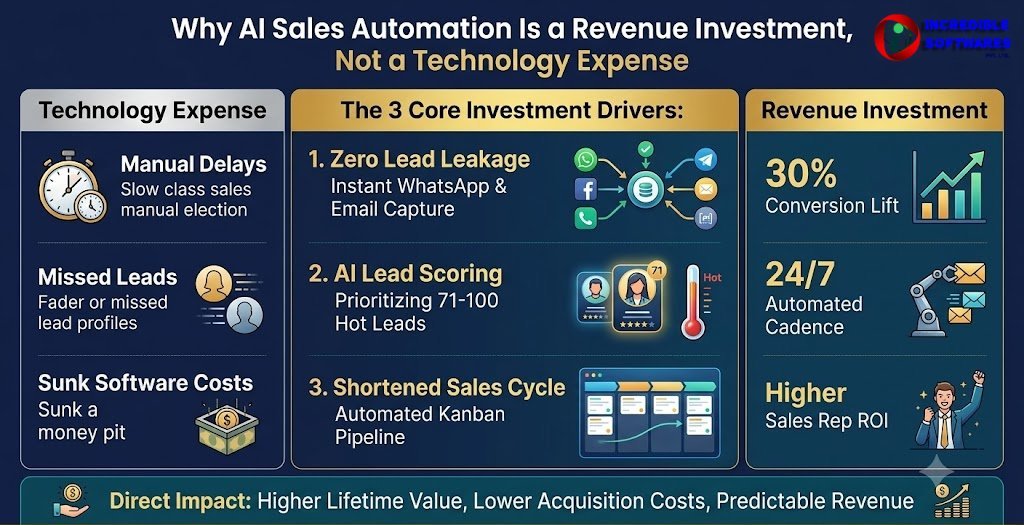
For many businesses, technology spending is still viewed through a cost lens: How much will this software cost us every month?
That question is understandable—but when it comes to AI-powered sales automation, it may be the wrong question.
The better question is:
How much additional revenue can we generate from the leads, salespeople, and marketing budget we already have?
That distinction changes everything.
AI sales automation is not simply another CRM, chatbot, or productivity tool. When implemented correctly, it can become a revenue infrastructure that helps businesses respond faster, prioritize better opportunities, follow up consistently, nurture prospects, and identify where revenue is being lost.
The AI sales automation platform offered by Incredible Softwares is positioned around this exact model. Its platform combines lead capture, AI lead scoring, WhatsApp and email automation, sales pipeline management, nurturing, proposals, AI recommendations, activity tracking, and revenue reporting in one system.
The result is a fundamental shift:
Technology expense → Sales efficiency → Higher conversion → Lower acquisition cost → More revenue.
AI Sales Automation Is About Revenue, Not Just Automation
A traditional software purchase is often justified by productivity.
For example:
- Save employees 5 hours per week
- Reduce manual data entry
- Store customer information
- Generate reports faster
Those benefits are useful, but sales automation has a much more direct connection to revenue.
Consider a business generating:
- 1,000 leads per month
- ₹2,00,000 monthly marketing expenditure
- 30 customers per month
- ₹25,000 average customer value
That produces:
30 × ₹25,000 = ₹7,50,000 monthly revenue
Now suppose the company doesn't increase its marketing budget or lead volume but improves its conversion rate from 3% to 4%.
It now generates:
1,000 × 4% = 40 customers
At the same ₹25,000 average customer value:
40 × ₹25,000 = ₹10,00,000
That's ₹2,50,000 additional monthly revenue without buying another 1,000 leads.
This is why AI sales automation should be evaluated as a revenue investment.
Your Existing Leads Are Already a Revenue Asset
Businesses often focus heavily on lead generation.
They invest in:
- Google Ads
- Meta Ads
- SEO
- Content marketing
- Email campaigns
- Events
- Referrals
But once a lead enters the database, the marketing team often considers its job finished.
That's where revenue leakage begins.
A lead may:
- Never receive a timely response
- Be assigned to the wrong salesperson
- Receive one follow-up instead of seven
- Get forgotten after a quotation
- Become interested again months later but receive no outreach
- Remain buried among hundreds of low-quality leads
The Incredible Softwares platform is specifically structured to capture leads from website forms, Excel/CSV files, APIs, WhatsApp opt-ins, email responses, and manual entry, then move them through a defined sales process.
Key pinpoint
A lead that has already been acquired represents sunk acquisition cost. Improving its conversion is often more efficient than continuously spending more money to replace it.
AI Lead Scoring Turns Sales Attention Into a Revenue Strategy
Not every lead deserves the same amount of sales attention.
A prospect requesting a proposal today is fundamentally different from someone who downloaded an article three months ago.
The platform uses a 0–100 AI lead-scoring model, categorizing leads as:
- 0–30: Cold
- 31–70: Warm
- 71–100: Hot
The scoring model considers activities such as website visits, email opens, link clicks, replies, budget matching, and proposal requests. Scores are designed to change as the prospect interacts with the business.
This has a direct financial impact.
Imagine five salespeople each handling 200 leads.
Without prioritization, they may spend considerable time calling low-intent prospects.
With intelligent scoring, the team can focus first on prospects displaying stronger buying signals.
The financial equation becomes:
Same leads + Same sales team + Better prioritization = More selling time spent on revenue opportunities.
Pinpoint
AI doesn't have to replace salespeople to create ROI. It can make every salesperson more productive by helping them spend time where the probability of revenue is highest.
Follow-Up Automation Protects Revenue You Have Already Paid For
One of the most expensive problems in sales is not losing a customer to a competitor.
It's forgetting to follow up.
The platform provides a seven-touch communication cadence spanning Day 0, Day 1, Day 3, Day 5, Day 7, Day 10, and Day 14, using WhatsApp and email, with automation stopping when the prospect replies or converts.
This is important because salespeople are human.
They have:
- Meetings
- Calls
- Quotations
- Existing customers
- Internal responsibilities
- New leads arriving every day
Manual follow-up eventually becomes inconsistent.
Automation creates a repeatable process.
Pinpoint
A follow-up system converts sales discipline from an individual habit into an organizational asset.
AI Can Reduce Customer Acquisition Cost
Customer Acquisition Cost (CAC) is one of the most important metrics for a growing business.
A simple formula is:
CAC = Total Sales & Marketing Cost ÷ New Customers Acquired
Suppose a company spends ₹5 lakh per month on sales and marketing.
Scenario A
50 new customers:
₹5,00,000 ÷ 50 = ₹10,000 CAC
Scenario B — After Better Conversion
The same ₹5 lakh produces 70 customers:
₹5,00,000 ÷ 70 = ₹7,143 CAC
The business has effectively reduced its acquisition cost by approximately 28.6% without necessarily reducing its marketing expenditure.
That's where sales automation becomes financially interesting.
The objective isn't necessarily:
"Spend less."
It's:
"Generate more revenue from every rupee already being spent."
Automation Can Improve Sales Without Increasing Headcount
Suppose a sales representative manages 200 leads.
If 40% of their time is spent on repetitive activities—reminders, follow-ups, status updates, email communication, data entry, and task management—then a significant portion of their working day isn't being spent on actual selling.
The Incredible Softwares platform automates communication sequences, task reminders, notifications, lead scoring, pipeline updates, nurturing, and other repetitive sales activities.
That doesn't mean the salesperson becomes unnecessary.
Instead, their time can move toward:
- Discovery calls
- Consultations
- Negotiations
- Demonstrations
- Proposal discussions
- Closing
- Relationship building
Your Existing Leads Are Already a Revenue Asset
Businesses often focus heavily on lead generation.
They invest in:
That's where revenue leakage begins.
A lead may:
- Never receive a timely response
- Be assigned to the wrong salesperson
- Receive one follow-up instead of seven
- Get forgotten after a quotation
- Become interested again months later but receive no outreach
- Remain buried among hundreds of low-quality leads
Key pinpoint
A lead that has already been acquired represents sunk acquisition cost. Improving its conversion is often more efficient than continuously spending more money to replace it.
Pinpoint
- 0–30: Cold
- 31–70: Warm
- 71–100: Hot
This has a direct financial impact.
Same leads + Same sales team + Better prioritization = More selling time spent on revenue opportunities.
Pinpoint
Follow-Up Automation Protects Revenue You Have Already Paid For
It's forgetting to follow up.
This is important because salespeople are human.
They have:
The ROI of automation often comes from reallocating expensive human time from administration to revenue-generating activities.
Revenue Forecasting Makes the Pipeline Financially Visible
A CRM can tell you that you have 500 leads.
A revenue-oriented sales platform should help answer:
How many of those leads are likely to become customers?
The platform includes pipeline reporting, source-wise reports, agent performance dashboards, conversion reporting, and revenue forecasting. Its sales pipeline covers stages including New, Contacted, Qualified, Proposal, Follow-up, Negotiation, Won, and Lost.
This allows management to move from:
"We have many leads."
to:
"We have ₹X of potential revenue across qualified and proposal-stage opportunities."
That is a much more useful management conversation.
AI Recommendations Turn Data Into Action
Data alone doesn't generate revenue.
Action based on data does.
The platform's AI recommendation functionality is designed to predict conversion probability, suggest the next best action, recommend follow-up timing, generate email drafts, and identify dormant leads.
For example, the platform demonstrates scenarios such as:
A lead has high engagement and matching budget → prioritize the lead.
Or:
A lead has been inactive → move it into a nurture or re-engagement workflow.
This creates a closed loop:
Data → AI insight → Sales action → Customer response → Updated score → Next action
That's considerably more valuable than a static database.
ROI Should Be Measured Against Incremental Revenue
The biggest mistake companies make when calculating technology ROI is measuring software usage instead of business outcomes.
Don't only measure:
- Number of automated emails
- Number of leads imported
- Number of WhatsApp messages
- Number of users
- Number of CRM records
Scenario A
Scenario B — After Better Conversion
₹5,00,000 ÷ 70 = ₹7,143 CAC
The business has effectively reduced its acquisition cost by approximately 28.6% without necessarily reducing its marketing expenditure.
"Spend less."
Automation Can Improve Sales Without Increasing Headcount
That doesn't mean the salesperson becomes unnecessary.
Instead, their time can move toward:
Measure:
Conversion Rate
Customers ÷ Leads × 100
Revenue Per Lead
Total Revenue ÷ Total Leads
Customer Acquisition Cost
Total Acquisition Cost ÷ New Customers
Sales Cycle
Average time from lead creation to conversion
Follow-Up Coverage
Leads receiving planned follow-ups ÷ Total eligible leads
Sales Productivity
Revenue ÷ Salesperson
AI Automation ROI
A simple model is:
ROI = (Incremental Gross Profit − Automation Cost) ÷ Automation Cost × 100
For example, suppose automation costs ₹1,00,000 annually and contributes to an additional ₹6,00,000 in gross profit.
ROI = (₹6,00,000 − ₹1,00,000) ÷ ₹1,00,000 × 100
ROI = 500%
This is an illustrative calculation, not a guaranteed result. Actual ROI depends on lead volume, margins, conversion rates, implementation quality, sales processes, and customer value.
Success Stories: Evidence From the Platform
The Incredible Softwares landing page includes testimonials from sales leaders describing their experience with the platform. These are customer testimonials presented on the company's website, rather than independently audited case studies, so the results should be treated accordingly.
TechNova Solutions
Ravi Sharma, identified on the page as VP Sales at TechNova Solutions in Delhi, says the company's follow-up rate increased from 30% to 95% within the first month and attributes three closed deals to WhatsApp automation that might otherwise have been missed.
Conversion Rate
Customer Acquisition Cost
TechNova Solutions
The financial lesson is straightforward:
Better follow-up coverage can recover revenue from opportunities already inside the funnel.
FastGrowth Realty
Priya Nair, identified as Sales Head at FastGrowth Realty in Mumbai, says AI lead scoring helped the team stop spending excessive time on cold leads and that its conversion rate doubled within six weeks.
Whether those results can be replicated depends on the business, but the underlying principle is broadly applicable:
Salespeople should spend disproportionate attention on prospects with stronger buying signals.
SaaS Partner Network
Anil Verma, identified as Director at SaaS Partner Network in Bangalore, highlights the platform's multi-tenant architecture, subscription controls, and detailed activity logging.
For larger sales organizations and SaaS businesses, operational control can itself become financially valuable because it makes scaling teams and accounts more manageable.
What Makes AI Sales Automation a Revenue Investment?
The difference can be summarized in five points.
1. It protects existing marketing investment
You don't lose the value of a lead simply because a salesperson missed a follow-up.
2. It increases sales productivity
Salespeople spend more time selling and less time managing repetitive tasks.
3. It improves lead prioritization
AI helps teams distinguish high-intent prospects from low-intent contacts.
4. It creates measurable accountability
Managers can track lead sources, pipeline stages, follow-ups, agent performance, conversions, and revenue.
5. It creates scalable sales processes
A growing company shouldn't have to reinvent its sales process every time it adds ten more salespeople.
FAQs
Is AI sales automation suitable only for large companies?
No. Smaller businesses can benefit significantly because automation can provide structured sales processes without requiring a large sales-operations team. The platform currently lists plans ranging from a Starter tier for up to three agents to Enterprise plans with custom capabilities.
Does AI replace salespeople?
No. The strongest use case is AI + human salespeople. AI handles repetitive processes, scoring, recommendations, reminders, and automated communication while salespeople handle conversations, relationships, negotiation, and closing.
Can AI sales automation reduce marketing costs?
Potentially, but that should not be the primary objective. A more powerful goal is to increase revenue from the same marketing investment. If conversion improves, the effective cost per customer can decline.
What businesses benefit most?
Businesses with regular lead generation, multiple salespeople, repetitive follow-up, longer sales cycles, quotation processes, or substantial lead leakage are particularly well positioned to benefit.
How quickly can ROI be measured?
Some operational improvements—such as response time, follow-up completion, and lead distribution—can be measured almost immediately. Revenue ROI generally requires enough sales-cycle data to compare conversion and revenue against a pre-automation baseline.
Does the platform support WhatsApp?
Yes. The platform describes WhatsApp Business API integration with templates, broadcasts, auto-replies, chat history, delivery/read tracking, and reply-triggered automation pauses.
The Bottom Line: Don't Ask "What Does AI Cost?"
The better question is:
"How much revenue are we currently losing because our sales process isn't following up, prioritizing, nurturing, and converting leads efficiently?"
If your business generates 1,000 leads but converts only 30 customers, the opportunity may not be another 1,000 leads.
The opportunity may be hidden inside those existing 1,000.
AI sales automation can help businesses systematically capture that opportunity through instant communication, intelligent lead scoring, automated follow-ups, nurturing, pipeline visibility, AI recommendations, and revenue analytics.
The most successful organizations won't necessarily be those that buy the most technology.
They will be the ones that connect technology directly to business outcomes.
More qualified opportunities.
More consistent follow-ups.
More productive salespeople.
Lower revenue leakage.
Higher conversion.
Better ROI.
That is why AI sales automation should not be treated merely as a technology expense.
It should be evaluated as an investment in your company's revenue engine.